
Scott International Procedures
Even if your flight plan never puts you on a NAT Track, knowing where the tracks are and how traffic flows along them matters when a contingency changes the plan.

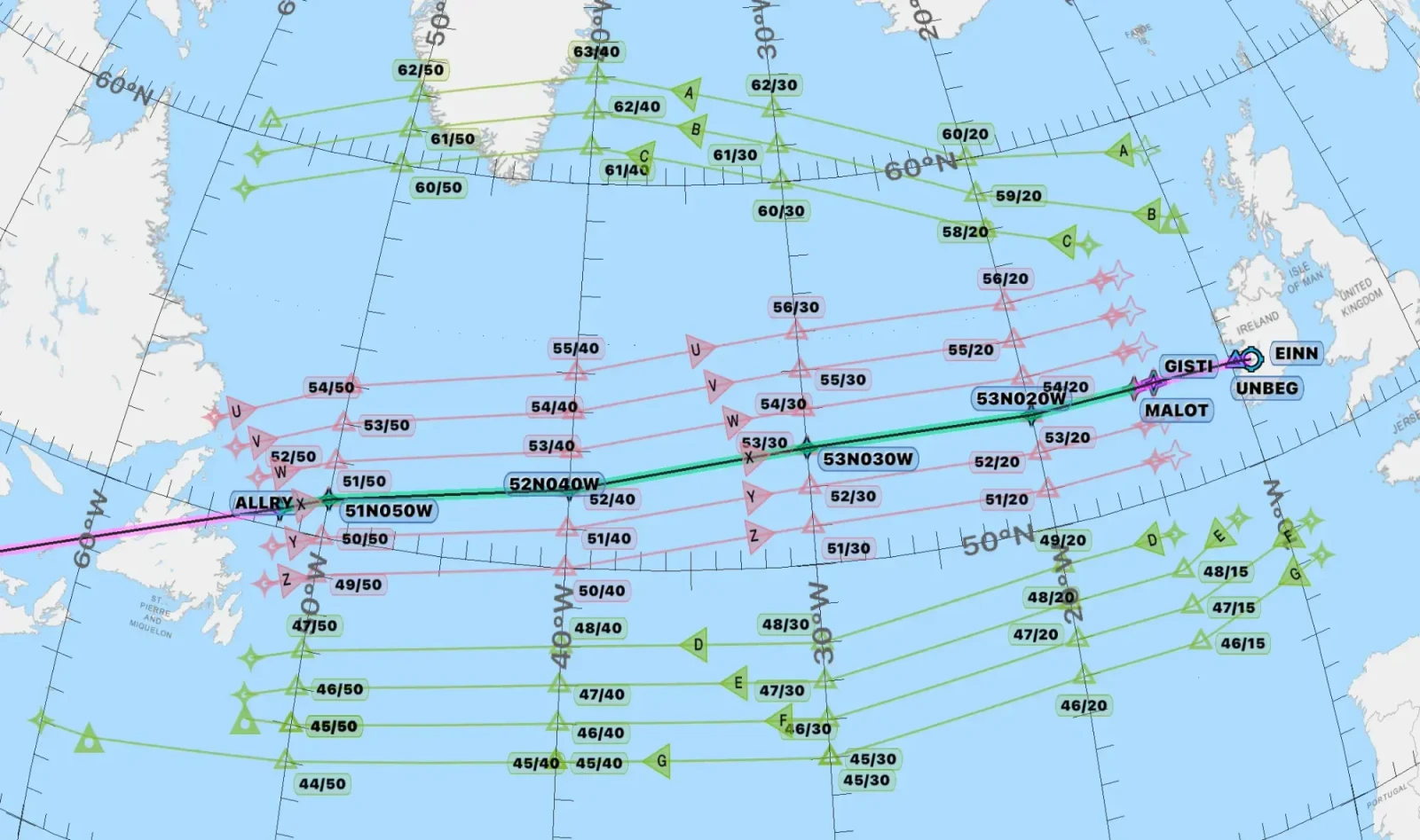
Part 4 of 4 in the Gary Dietz NAT Series, first published in the Scott IPC newsletter in September 2026.
From January through June 2026, there was an average of approximately 4,100 flights per day in the NAT HLA, the airspace above FL285 and below FL420. That equates to more than 1.2 million flights annually.
With that much traffic crossing the North Atlantic, understanding how the Organized Track System (OTS) is operating is important, even if your flight plan never puts you on a track.
The NAT Tracks are designed twice during each 24-hour period, taking into consideration the shifting jet stream, weather, and the flow of transatlantic traffic. The objective is to provide an organized structure for efficiently moving large numbers of aircraft across the North Atlantic.
For business aviation, however, the question isn’t necessarily: “Should I fly the tracks?”
A better question may be:
“What can the tracks tell me about today’s North Atlantic operation?”
Most business aviation flight planning systems and providers are looking for an efficient route based on the parameters and preferences prescribed by the operator. Minimum time is often a primary driver in determining the proposed route and altitude.
For a business jet, the resulting flight plan may take the aircraft over or around the published tracks rather than placing it directly on one. That doesn’t make the tracks irrelevant.
The OTS provides crews with a picture of where a significant portion of the day’s transatlantic traffic is expected to operate and how that traffic is organized. Looking at the tracks alongside your planned route can provide valuable situational awareness before you ever enter oceanic airspace.
Under normal circumstances, your flight may proceed exactly as planned. But good international preparation also considers what happens when it doesn’t.
Weather, turbulence, aircraft performance, medical situations, system issues, or other operational circumstances can require a crew to change altitude, reroute, or divert to an alternate. That’s when knowing the location and direction of the NAT Tracks can become particularly valuable.
If you’re operating above or outside the track structure and a contingency requires you to descend, deviate, reroute, or divert, your relationship to the organized traffic flow can change quickly. Knowing where the tracks are, and how traffic is moving along them, provides important situational awareness when the original plan changes.
The first time you think about that traffic shouldn’t be when you’re dealing with the contingency.
The lesson isn’t that business aviation crews should always fly the NAT Tracks. Depending on the aircraft, winds, destination, altitude, and flight planning parameters, a route over or around the tracks may be the better option.
The lesson is that the tracks still matter even when you’re not on them. Before crossing the North Atlantic, understand:
Then consider how that picture might change if you need to descend, deviate, reroute, or divert.
Your flight plan tells you where you intend to go. Understanding the NAT Tracks helps you understand what may be around you if the plan changes.
REFERENCED REGULATIONS
FAA AC 91-70B
NAT Doc 007 Ver 2026.1
ICAO Doc 4444 PANS-ATM
ICAO Annex 11
NAT OPS Bulletin 2025-3
AUTHOR
Gary Dietz is an Instructor and Curriculum Developer at Scott IPC and a retired corporate Chief Pilot with 48 years of service, including leadership roles on the NBAA International Operators Committee.
STAY CURRENT
Regulatory changes, procedure updates, and instructor insights. About one email a month. No marketing fluff.
you@flightdepartment.com
SubscribeWe don't share email addresses. Unsubscribe at any time.