Scott International Procedures
New oceanic in-flight contingency and weather-deviation procedures, effective Mar 28, 2019, reduce the lateral offset from 15 NM to 5 NM alongside the ASEPS trials.

The use of the new procedures for Oceanic Contingencies and Weather deviation Procedures is coincident with the start of the Advanced Surveillance-Enhanced Procedural Separation, known as (ASEPS) trials which takes advantage of Space Based (SB ADS-B). The SAT ADS-B trials will in effect reduce our separation requirements and allow ATC to apply these reductions if the aircraft is equipped with FANS 1/A+ CPDLC, ADS-C, RNP4, RCP240, and RSP180 capable and equipped with ADS-B. The new procedures go into effect 28 March 2019. Your Scott IPC App containing these procedures will be updated to reflect the new procedures on the 28th as well.
The following is only a brief overview of the new procedures. Please ensure you read the NAT Ops Bulletin cited and linked below.
ADS-B was developed to be used over the VHF ground ATS network. With the new use of ADS-B over Satellite, ATC can gather information to allow the reduction of separations in Oceanic and Remote Oceanic airspaces. With this reduction of separation comes the need to deconflict aircraft in a contingency situation where they have left the assigned route without a clearance from ATC. The current contingency procedures in use today must be used until the space based ADS-B trials begin in March 2019. When the ASEPS trials start, any aircraft experiencing the following situations would follow these new procedures:
The new Special Procedures for In-Flight Contingencies in Oceanic Airspace effectively reduces the offset from 15 NM off route to 5 NM off route, flying parallel to the assigned cleared route. You will also notice that there is no altitude loss or gain as you drive out to the 5 NM parallel offset. Today's rules have you descend or climb 500 ft (if below FL410) when you are 10 NMs off course enroute to a 15 NM parallel offset. Again, it will be 5 NM offset with no climb or descent before reaching the offset. Once on the offset:
Note. Descent below FL290 is considered particularly applicable to operations where there is a predominant traffic flow (for example, east-west) or parallel track system where the aircraft's diversion path will likely cross adjacent tracks or routes. A descent below FL290 can decrease the likelihood of conflict with other aircraft, ACAS RA events, and delays in obtaining a revised ATC clearance.
These new procedures will apply regardless of the routing you are flying, i.e. the tracks or a random route (what they call User Preferred Routings).
WEATHER DEVIATION PROCEDURE:
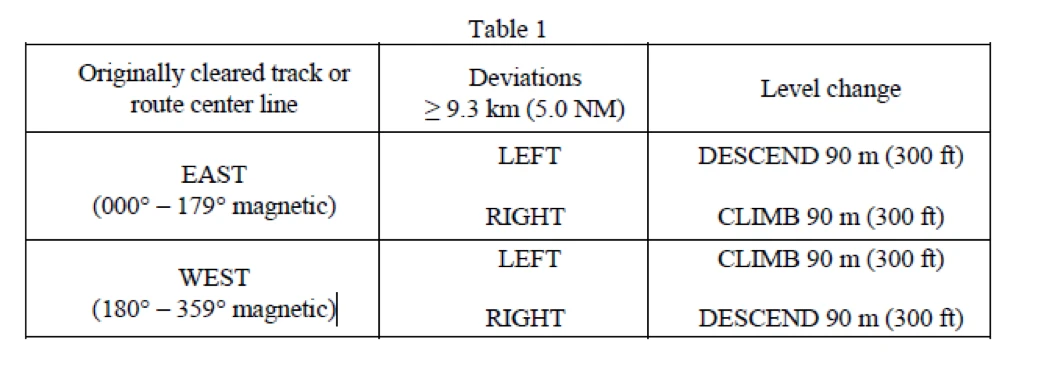
The Weather Deviation Procedure will also change on 28 March 2019. The change to this procedure concerns the trigger point for a 300 ft climb or descent. If the aircraft cannot obtain a clearance to deviate for weather then they would initiate a climb or descent of 300 ft passing 5 NMs off route. The ICRH® will reflect this change on 28 March 2019. The current procedures are to be used until that time.
Resources:
Take the time to read the new NAT Ops Bulletin 2018_005 rev 1.
REFERENCED REGULATIONS
FAA AC 91-70B
NAT Doc 007 Ver 2026.1
ICAO Doc 4444 PANS-ATM
ICAO Annex 11
NAT OPS Bulletin 2025-3
AUTHOR
The Scott IPC instructor team: retired corporate chief pilots, FAA procedures and safety personnel, and former military aviators who teach international procedures.
STAY CURRENT
Regulatory changes, procedure updates, and instructor insights. About one email a month. No marketing fluff.
you@flightdepartment.com
SubscribeWe don't share email addresses. Unsubscribe at any time.