Scott International Procedures
NAT Doc 007 (July 2020) updates the Tango Routes: state approval is now required and the transponder Code 2000 change is made 10 minutes after joining T9/T290.

On January 30, 2020, Phase 2c of the North Atlantic Data Link Mandate (NAT DLM FL290-FL410) went into effect. CPDLC is still required on T213, T13, and T216 in the SE corner of Shanwick Oceanic. Routes T9 and T290 positioned just west of the BOTA airspace do not require CPDLC but have specific Transponder requirements.
ICAO has published an updated version of the NAT Doc 007, applicable from July 2020, with some minor changes regarding the Tango Routes. The specifics of these changes are found in Chapter 6, sections 6.8.1 and 6.8.2.
6.8 OPERATION OF TRANSPONDERS
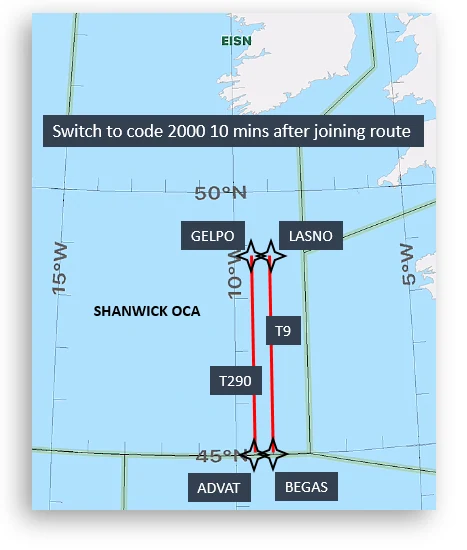
6.8.1 - All aircraft operating as IFR flights in the NAT Region shall be equipped with a pressure-altitude reporting SSR transponder. Unless otherwise directed by ATC, pilots flying in NAT airspace will operate transponders continuously in Mode A/C Code 2000, except that the last assigned code will be retained for a period of 30 minutes after entry into NAT airspace or after leaving a radar service area. Pilots should note that it is important to change from the last assigned domestic code to Code 2000. The original domestic code may not be recognized by the subsequent Domestic Radar Service on exit from the oceanic airspace. However, because of the limited time spent in the NAT HLA, when flying on route Tango 9 or Tango 290, the change from the last assigned domestic code to Code 2000 should be made Northbound 10 minutes after passing BEGAS or ADVAT and Southbound 10 minutes after passing LASNO or GELPO.
6.8.2 - It should be noted that this procedure does not affect the use of the special purpose codes (7500, 7600, and 7700) in cases of unlawful interference, radio failure, or emergency. However, given the current heightened security environment, flight crews must exercise CAUTION when selecting Codes not to inadvertently cycle through any of these special-purpose codes and thereby possibly initiate the launching of an interception.
The two particular points of interest are that state approval is now required to operate on these Tango routes, and specific transponder procedures are in place when using T9 and T290. Usually, a transponder code change is required to 2000, thirty minutes after NAT HLA entry, but because of the limited time spent in the airspace, when flying on T9 and T290, this change should be made ten minutes after joining either of these routes.
T9 is southbound only, using even levels between FL300-400. T290 is northbound only, using odd levels from FL290-410. For more info on the Tango Routes, see UK AIP ENR 3.5 or NAT Doc 007 Chapter 3, which identifies route structures, including Blue Spruce Routes and Tango Routes.
REFERENCED REGULATIONS
FAA AC 91-70B
NAT Doc 007 Ver 2026.1
ICAO Doc 4444 PANS-ATM
ICAO Annex 11
NAT OPS Bulletin 2025-3
AUTHOR
The Scott IPC instructor team: retired corporate chief pilots, FAA procedures and safety personnel, and former military aviators who teach international procedures.
STAY CURRENT
Regulatory changes, procedure updates, and instructor insights. About one email a month. No marketing fluff.
you@flightdepartment.com
SubscribeWe don't share email addresses. Unsubscribe at any time.